
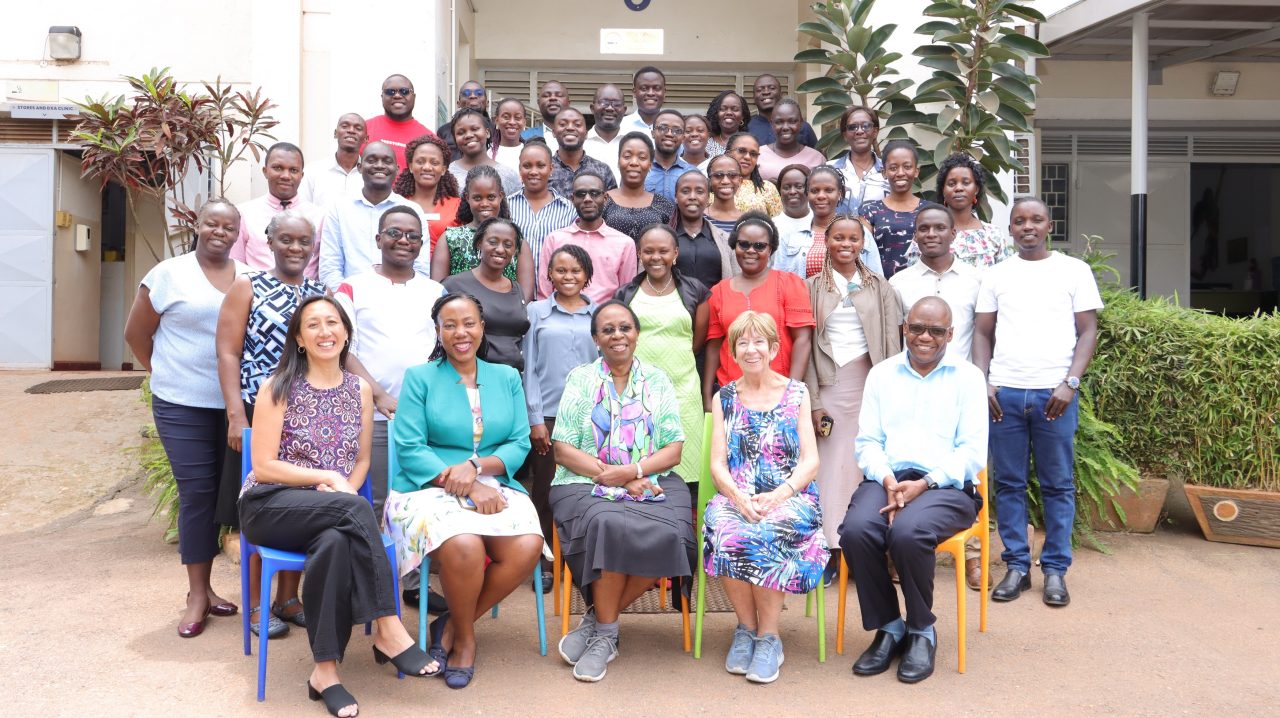
From July 27th to 31st, 2026, the MU-JHU conference room was filled with nurses, pharmacists, bioethicists, regulatory professionals, social workers, community advisory board members, and doctors who were actively engaged in learning more about how HIV-related clinical trials are designed and run, especially with vulnerable research populations like pregnant women, infants, children, and adolescents. This was the third cohort of MU-JHU’s core course as part of the D43 Training, a capacity-building program strengthening Ugandan researchers’ ability to conduct HIV treatment and prevention trials in perinatal, pediatric, adolescent, and at-risk populations. It opened, as the previous two cohorts had, with Executive Director Professor Philippa Musoke welcoming the diverse new class to a long-standing history stretching back more than three decades. MU-JHU has been running perinatal HIV research since 1993, built on foundational relationships led by visionary clinicians such as the late pediatrician Professor Christopher Magala Ndugwa and the late obstetrician Professor Francis Mmiro, in partnership with colleagues who first crossed paths at Case Western Reserve University before the collaboration’s academic home moved to Johns Hopkins. ‘Our mission and vision are to have a positive impact on the health of our people, including the women, the adolescents, their children, and their families,’ Prof. Musoke told participants. ‘It’s not only the Ugandan population, but the global community. We must conduct research that is relevant to the population, and when we conduct research, we want to impact global health, not only Ugandan health.’ That mandate explained the range of people MU-JHU gathered in the room to address the need for supporting interdisciplinary teams as regulatory officers sat beside bioethics fellows and HIV program coordinators sat beside community advisory board members who represent participants’ interests back in the communities where trials actually happen. When each was asked, in turn, to name what they hoped to leave with, the answers stacked up into their shared expectations for a productive week ahead. Responses included wanting to learn about how to ethically involve pregnant mothers in trials, how artificial intelligence might one day ease the burden of participant follow-up, how to translate published findings into fundable new trial concepts, and how to navigate parental permission when a father is absent, unreachable, or simply unaware his child has been enrolled.

Day one had sessions that taught a lot about history and methodology. Professor David Serwadda, one of the earliest researchers to describe what was then known in Uganda as ‘slim disease’ in the 1980s, is a foundational figure in African HIV prevention and treatment research. He walked participants through the history of primary prevention trials for HIV, tracing the field from its earliest and most uncertain years to the present. Professor Sarah Kiguli, a pediatrician and leader in health professions education, followed with key points about the unique aspects of conducting pediatric trials in a session that set up a theme which would be revisited again and again, emphasizing that children are not simply small adults and treating them as such in a trial design is itself an ethical and scientific failure. She shared the history of pediatric HIV clinical trials, tracing the field’s origins to advocacy groups like the Elizabeth Glaser Pediatric AIDS Foundation, which lobbied the US Congress for dedicated funding. The first pediatric studies tested single drugs like ZDV in the mid-1990s. However, combination antiretroviral therapy did not reach children in resource-limited settings like Uganda until the early-to-mid 2000s, nearly a decade after it reached children in the US and Europe. That gap between when a treatment becomes available somewhere and when it becomes available everywhere sat quietly under almost every session that followed. Dr. Deo Wabwire, the D43 program director, closed the day with an overview of the wider opportunities, which include short-course modules running six to eight weeks, and practicum placements for participants who want to learn and apply skills in hands-on settings to go further than lectures can take them.
Day two turned to pharmacokinetics, the science of what a drug actually does once it enters a body that is, in pregnancy, doing the work of two. Professor Brookie Best walked participants through pharmacokinetic considerations for studies involving pregnant, lactating, and pediatric populations, using real concentration-time curves from MU-JHU’s IMPAACT and PROMISE studies, which have tracked more than 25 anti-HIV and anti-tuberculosis drugs through pregnancy in thousands of women and infants. She showed how some drugs barely change, such as efavirenz concentrations in the third trimester, which tracked almost exactly with levels seen in non-pregnant adults. Others swing sharply and unpredictably. One drug, metabolized by four different liver enzymes, saw its concentration rise nearly threefold in the third trimester because two of the relevant enzymes slow down in pregnancy while two others speed up. Darunavir boosted with cobicistat told a different story, though concentrations fell so far during pregnancy that a fifth to a third of patients dropped below the level needed to suppress the virus, a finding that led to changes in the clinical guidance outright. The lesson participants took away was that none of this can be predicted from adult data alone, and yet the world typically waits a median of six years after a drug’s approval in adults before anyone studies how it behaves in pregnancy at all. Dr. Christine Sekaggya Wiltshire followed with a parallel presentation about pharmacokinetic variability in anti-tuberculosis drugs during pregnancy and the newborn period, before Dr. Deo Wabwire returned to address pediatric co-infections and the added complexity that TB brings to a child already managing HIV. Dr. Enid Kabugho presented findings from IMPAACT P1078, and Dr. Maxensia Owor closed the science block with pediatric and adolescent trial data from IMPAACT 2017. The lectures built the scientific foundation, and the breakout sessions led to robust discussions as attendees explored challenges faced during real-world dilemmas. Small groups, led by Professor Mary Glenn Fowler, Dr. Maxensia Owor, Dr. Sheila Bamweyana, and Dr. Deo Wabwire, were each handed a different MU-JHU trial as a case study to discuss, representing perinatal studies (PROMISE), pediatric studies (P1093), adolescent studies (HPTN 084-01), and TB studies (IMPAACT 1026s). Participants were asked to walk through the trial schema and come up with every implementation issue they could find. Each group worked from the same prompts and explored key issues related to recruitment, consenting and assent, study drug dosing and formulations, and retention. The PROMISE group’s report-back ran long as their trial had enrolled pregnant women into an antepartum arm comparing triple antiretroviral therapy against the era’s standard of care, and a postpartum arm testing maternal triple-drug therapy against giving the infant nevirapine throughout breastfeeding. The ethical issues participants surfaced were concrete and, in several cases, still live, including insufficient safety data on triple therapy in pregnancy at the time the trial launched. The challenge of consenting fathers who were simply not present when a mother enrolled or mothers under-reporting or misremembering how long they had already been on antiretroviral therapy was raised more than once, in more than one breakout. The risk posed by enrolling in an HIV study is that participation could lead to inadvertent disclosure of a woman’s status to a husband who didn’t know it yet. ‘This was a risk of social harm, one presenter told the room,’ especially where the husband doesn’t know the status of the wife, and here you are telling them to enroll in a study whereby somehow the partner may end up knowing.’ The pediatric group, working through a seven-year, 300-participant, safety and dosing study spanning infants as young as four weeks to adolescents under 18, raised a different set of problems entirely which included the near-impossibility of using public recruitment channels like radio for a population that sensitive, the difficulty of dosing dispersible tablets accurately when a caregiver, not a clinician, is the one administering the drug at home, children vomiting a dose and no one being sure how much was actually absorbed and retention breaking down as children grow, change schools, or head off to boarding school mid-trial.
By midweek, the training had shifted from ethical challenges to the statistical structure of clinical research, as Professor Yawe Guwatudde led participants through the design principles and analytical concepts that underpin a clinical trial. He began with the population at risk, then moved through sampling and randomization before outlining the three trial phases that distinguish an early safety study from a trial large enough to influence practice. Phase I trials, he explained, are the first tests of a new substance in humans and typically involve 20 to 100 participants, with safety as the sole objective. Phase II, often described as the proof-of-concept stage, looks for early evidence that the intervention is affecting the intended outcome and usually includes 100 to 300 participants. Phase III trials, which involve more than 300 participants, are where efficacy is established, while safety remains a secondary priority throughout. He also explained interim analyses, the alpha-spending function that controls how often a trial can inspect its own data without inflating the risk of a false-positive result, and the stopping rules that determine when a trial should be halted. These triggers, he noted, are independently reviewed by the Data Safety Monitoring Board. He further stressed that every participant in every arm must receive at least the standard of care. Professor Yawe also argued that missing data should be treated as a trial-design and trial-conduct problem, not merely a statistical one. Practical solutions, he said, include clearly defined outcomes and follow-up schedules, standardized measurement instruments, SMS and WhatsApp reminders, ethically and institutionally appropriate transport reimbursement, and a deliberate process for tracing participants who miss scheduled visits rather than simply treating them as lost.
Dr. Victoria Chou followed with a session on why independent oversight matters in perinatal, pediatric, and adolescent trials. Madam Maria Musisi then gave participants an overview of the regulatory processes and organizations that govern research in Uganda and the bodies whose approval stands between a protocol on paper and a trial in a clinic. Dr. Chou later returned to close the block with a discussion of study documentation requirements for perinatal and pediatric research, setting the stage for the ethics case studies that followed. On this day, breakout sessions were led by Dr. Victoria Chou, Ms. Winfred Luwedde, Madam Maria Musisi, and Ms. Paula Namayanja of the REC department at MU-JHU, who challenged participants with a series of case studies designed to resist easy answers. Each case involved consideration of the three core bioethics principles that include respect for persons, or the right to make one’s own choices and the added protection owed to those with diminished autonomy, such as children, the duty to maximize benefit and minimize harm through informed consent and careful risk-benefit assessment, and justice, or the fair distribution of research’s burdens and benefits and the protection of vulnerable populations from exploitation. One case, titled ‘Informed consent’, described a mother whose infant, born to a woman living with HIV, was eligible for a measles vaccine study. Another involved a mother who wanted to skip the consent form review. Together, the scenarios raised a question about what ‘informed’ consent actually requires when a participant is willing, trusting, and eager to say yes. In a small-group discussion, participants weighed the mother’s right to change course for her child against the study’s obligation to protect infant safety and preserve scientific integrity. A separate case, which dominated one afternoon’s discussion, involved a father who stormed into a clinic angry that his teenage son had been enrolled in an HIV peer-support study without his knowledge or consent, and demanding that the boy be withdrawn and all his data and specimens destroyed. Groups examined the problem from several angles. Was he really the father? Had a mother or guardian validly consented on the boy’s behalf? What if he had genuinely not been told about his son’s status? In the end, participants converged less on a single correct answer than on a sequence of actions: calm the situation, notify the principal investigator, verify the consent records to determine who authorized the boy’s enrolment, and only then respond to the father’s demands. As several participants noted, careful documentation can matter as much as making the right ethical call in the moment, because if a dispute escalates later, the file becomes the record on which the study will be judged.
The week ended by moving from the trials MU-JHU has already completed to those studies still underway. Dr. Clare Bukirwa presented on lenacapavir for HIV pre-exposure prophylaxis in the PURPOSE 1 trial (NCT04994509), the injectable PrEP candidate that has attracted global attention for its potential to change HIV prevention. Dr. Sheila Bamweyana then shared community advisory board perspectives about a multi-purpose drug’s monthly pill comparator arm, while Dr. Victoria Ndyanabangi closed the science program with an update on pediatric HIV cure research under IMPAACT P1115. Together, these sessions showed how the field is pushing forward toward advances in prevention, treatment, and the possibility of cure. Dr. Deo Wabwire brought the course to a close by thanking a room that had spent a week actively engaged and moving between hard evidence and difficult judgment calls, sometimes in the same conversation. What began on Monday morning with more than forty strangers became a network of colleagues who now share not only a week of slides, but also a shared language for questions that do not have easy answers: who can consent for a child whose father cannot be found, how much drug exposure is safe in pregnancy, and what it costs a study in trust and data when those decisions are made poorly. As one facilitator said near the end of the week, science does not stop being ethical work when the numbers finally appear in a table. As with the prior two sessions, the training ended with that same lesson that good research is not only about generating results, but about protecting people, building trust, and making careful decisions that will matter long after the course is over. To date, over 100 participants have completed the D43 core course and spent a busy week taking a deeper dive to learn more about key research topics.
The D43 Training is supported by Grant D43TW013049, an NIH Fogarty International Center International Research Training Grant awarded to MU-JHU CARE Ltd in partnership with Johns Hopkins University. Officially titled ‘Strengthening capacity of researchers in Uganda to conduct HIV treatment and prevention clinical trials in perinatal, pediatric, adolescent, and at-risk populations including women and their partners,’ the grant funds long-term doctoral and master’s-level training, postdoctoral fellowships for early-career Ugandan investigators, and short- and medium-term courses, such as this one, that build practical skills to design and run HIV treatment and prevention trials in these populations.
MU-JHU periodically posts calls for applications on its website. Interested individuals and teams are encouraged to visit our website at ‘https://www.mujhu.org’ or call our general inquiries line at ‘+256 200 404 100’ or email us at mujhu@mujhu.org for upcoming opportunities. Please note that all modules and training sessions are free. write-up
